Can I Bring A Backpack To The Eiffel Tower?
A small backpack passes the Eiffel Tower security gauge and a suitcase does not. The real bag rules, what happens at the check, and where to store a case nearby.
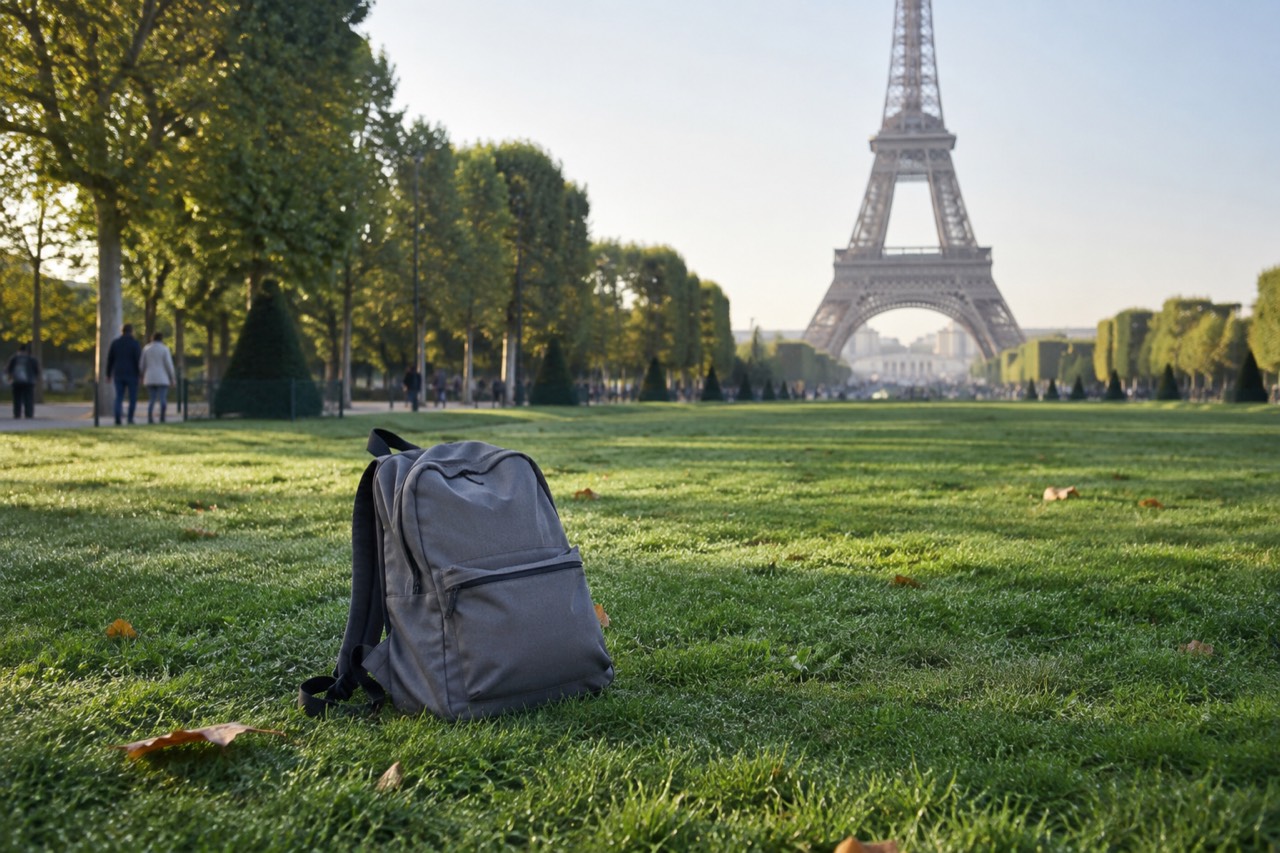
Can I Bring A Backpack To The Eiffel Tower?
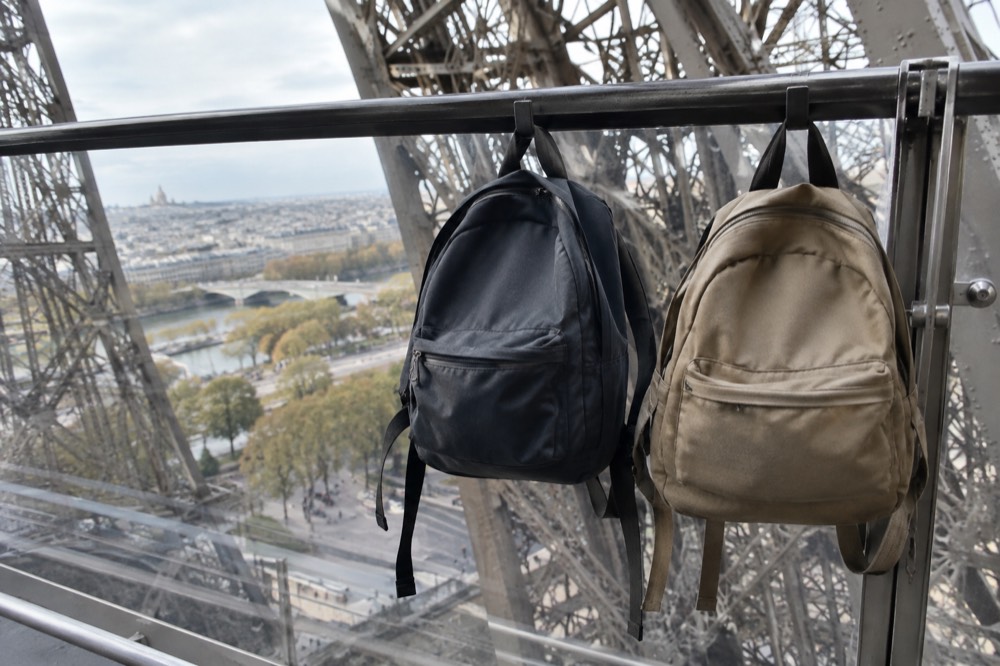
Yes, you can bring a backpack to the Eiffel Tower, provided it passes the size gauge at the security check. The tower publishes no maximum bag size in centimetres: a physical gauge at each security checkpoint decides, and any bag that does not fit is turned away. There is no cloakroom, no left-luggage office and no locker in or near the tower, so an oversized bag means missing the visit or storing it elsewhere first.
That is the whole answer in one breath, but the detail matters when you are standing on the Champ de Mars with a rucksack and a ticket time. The Eiffel Tower's own visitor guidance is unusually blunt on the storage question. It states there is no left luggage office at the Eiffel Tower and no cloakroom, and it goes further: there are no luggage lockers, storage or cloakrooms in or near the Eiffel Tower either. Most Paris landmarks at least offer a locker for small items. The tower offers nothing, which makes it the one major sight in the city where the bag decision has to be made before you arrive.
The reason is security architecture. Every visitor to the tower, whether going up or just walking beneath it, passes through a perimeter checkpoint where bags are screened. A small backpack goes through the X-ray like a handbag at an airport. A suitcase does not fit the flow at all, and the staff at the checkpoint have no place to put it even if they wanted to. This is not a policy that bends on a quiet Tuesday. The check exists and the gauge exists, and both apply year round.
So the practical split is simple. A daypack, a handbag, a small camera bag or a child's school-sized rucksack will normally pass without a second glance, subject to the gauge. A carry-on roller, a duffel you would check onto a plane, or anything with a rigid frame will not. If your plan is "arrive with the suitcase, do the tower, then head to the hotel", the suitcase needs a storage point first, and this site exists to help with exactly that. Luggage Storage in Paris covers where bags can be dropped near the tower and across the city, with real prices and real opening hours rather than marketing copy.
For a reader deciding right now, the nearest bookable options look like this:
The rest of this article walks through what the security check actually does, what happens when a bag fails the gauge, what nearby storage costs, and how to time the whole thing so you are not sprinting back for a bag with a summit ticket expiring.
What The Security Check Actually Does With Your Bag
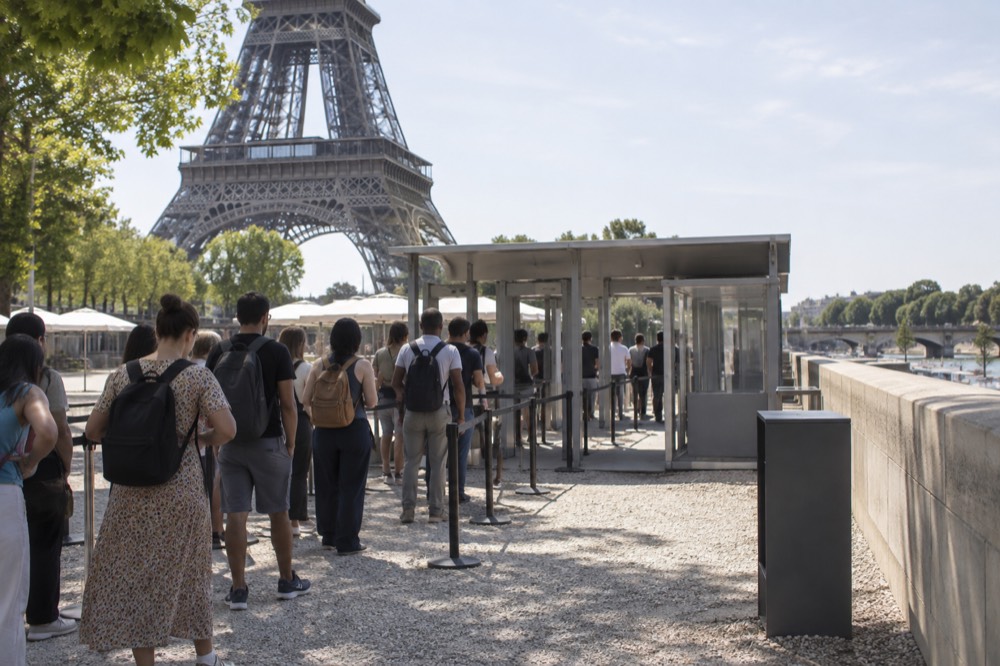
Every visitor passes a perimeter security checkpoint before reaching the tower, and every bag goes through X-ray screening. There are two checkpoints, one at the East pillar and one at the West, and both use a physical size gauge for luggage. Bags that fit the gauge and pass the screen go in; bags that do not fit are refused, and staff cannot hold them for you anywhere on site.
The check is closer to an airport than to a museum. Belts come off sometimes, pockets get emptied when asked, and the bag itself rides the X-ray belt while you walk through a body scanner. The queue moves reasonably fast, but on a summer morning it can stretch well back across the Champ de Mars, and a family with four backpacks adds minutes at the belt. If you are carrying a small backpack, the honest advice is to pack it sensibly before you join the line. Anything that looks odd on the screen, a tangle of cables, a power bank buried under clothes, a drone, a pocket knife forgotten in a side pocket, invites a manual search and slows everyone down.
Sharp objects and anything flagged under France's Vigipirate security posture are the obvious refusals. But the checkpoint refusal that surprises people is size. The tower's guidance says a luggage sizer indicating the maximum size is available to visitors at the security checks, and any luggage exceeding this size will not be accepted. Note what that sentence does not contain: a number. No centimetre figure is published anywhere on the tower's own site. Blog posts that quote an exact maximum for the Eiffel Tower are repeating a number the tower itself has never put in print. The gauge on the table is the only authority.
This is worth internalising, because it changes how you should read every other claim in this article's neighbourhood. The Louvre publishes its limit openly, 55 x 35 x 20 cm, and even runs free self-service lockers under the Pyramid for smaller items, as its visitor amenities page states. The Catacombs publish 40 x 30 x 20 cm and refuse suitcases outright, with no cloakroom, per the official visit rules. The Eiffel Tower publishes nothing except "whatever fits the gauge". A modest backpack, the kind you would carry on a plane as personal item, passes at every report. A 40-litre hiking pack is a coin toss. A suitcase is a certain no.
One more thing the security layout means: you cannot dodge the check by staying on the ground. The perimeter applies to the whole tower area, including the esplanade beneath the pillars. There is no version of "I'll just stand under it with my big bag while the others go up". If you are near the tower, you have passed the gauge, or you are on the far side of the fence on the lawn.
What Happens If Your Bag Is Too Big For The Gauge
A bag that fails the gauge is refused at the checkpoint, and there is nowhere on site to leave it. Your options are to abandon the visit, take the bag back to your hotel or apartment, or store it at a bookable storage point near the tower before rejoining the queue. Staff at the checkpoint cannot hold, watch or tag a refused bag under any circumstances.
The refusal itself is calm and quick. A staff member points at the gauge, shakes a head, and waves you back out of the line. There is no negotiation tier, no paid holding desk, no manager who can make an exception. The tower's own wording closes every door: no left luggage office, no cloakroom, no lockers in or near the tower. The nearest genuine storage options are local businesses that work with the Radical Storage network, shops, hotels and cafés that hold bags behind a counter; this site neither owns nor operates any of them. Every storage point recommended here is a real Radical Storage partner location; this site neither owns nor operates any of them.
The cluster near the tower is small but real. The Eiffel Tower area on this site lists 9 storage points, rated 4.8 across 1,559 reviews, with the earliest opening at 07:30 and the latest closing at 23:59. Hours vary point by point, exactly as they do across the whole network, so the hours that matter are the ones on the specific point you book, not a generic promise. Anyone who tells you Paris bag storage is available around the clock is repeating a template string, not a fact.
Timing is the part people get wrong. If your summit ticket is for 10:30 and you discover the gauge problem at 10:15, the nearest storage point may be a 10 to 15 minute walk each way, plus the drop-off itself, plus re-queuing at security. That is the visit gone. The fix is to treat the bag decision as part of buying the ticket, not a surprise at the fence. Drop the case on the way in, keep the daypack, and the checkpoint becomes a two-minute formality.
There is also a legal dimension worth knowing, because "just leave the bag somewhere for an hour" is no longer a harmless move in Paris. A French law of 28 April 2025 created tiered penalties for abandoned baggage across SNCF and RATP networks, from 72 EUR for involuntary abandonment up to 1,500 EUR for manifest voluntary abandonment, with a higher band for unlabelled bags. The law is aimed at stations and trains rather than lawns, but the principle travels: an unattended bag anywhere crowded triggers a security response. SNCF itself says dealing with an unattended bag takes 19 minutes on average. A staffed storage point is not just convenient, it is the option that does not involve a security perimeter.
Where To Store A Suitcase Near The Eiffel Tower
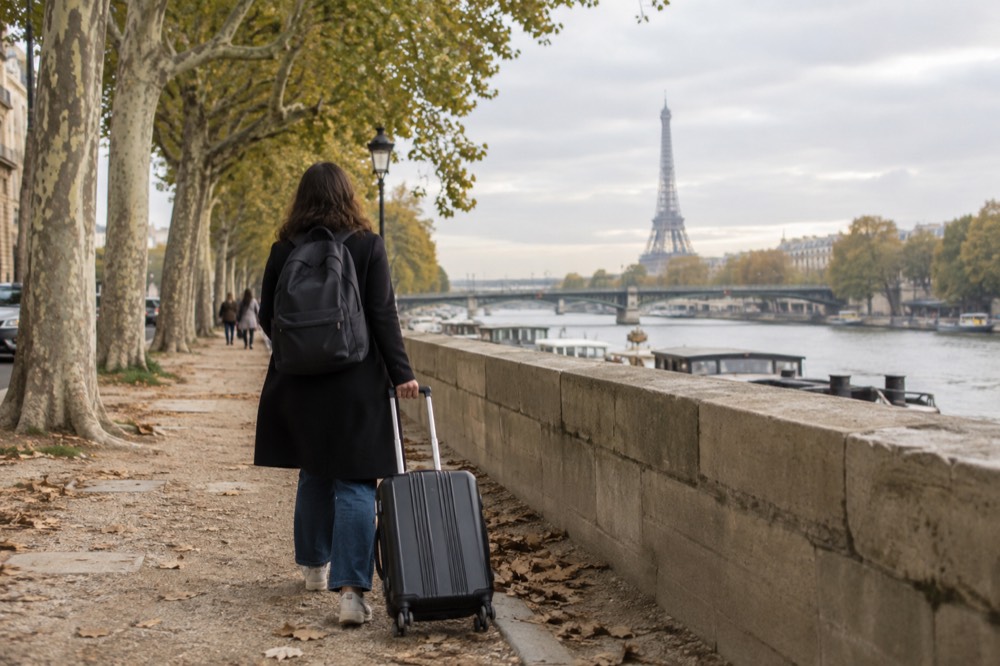
The realistic option is a Radical Storage partner point in the 7th arrondissement or across the river, at EUR 3.90 per bag per day plus a EUR 1.99 per-bag checkout fee, so one bag for one day is EUR 5.89 in arithmetic on those two published figures. There is no locker facility at the tower itself, and the network publishes no size or weight limit for stored bags.
The network point near the tower is the one this article keeps pointing at because it is the one that answers the actual question. Radical Storage's Paris product states plainly that there are no size or weight restrictions on stored bags, which matters when a museum locker will not take a checked suitcase but a partner shop behind a counter will. The day rate in Paris is EUR 3.90 per bag, and a EUR 1.99 per-bag fee appears at checkout. One bag for one day is therefore EUR 5.89, and three days with one bag is EUR 13.69, because the fee is charged once per bag and does not scale with nights. These totals are arithmetic on the network's two published figures, not an observed checkout, and the fee is exactly where it appears: at the checkout stage, not on the location card.
Cancellation is free any time before the scheduled check-in, with a full refund, which matters for tower plans. Paris weather and summit visibility change minds, timed tickets get shuffled, and a storage booking you can cancel without cost is one less locked-in commitment on a day that is already scheduled to the minute.
The alternative worth weighing honestly is the official SNCF station consigne, and this site's rule is to state its real prices and real limitations rather than pretend the network is the only option. The SNCF locker grid runs EUR 5.50 for a small locker, EUR 7.50 medium, EUR 9.50 large for a fixed 24 hours, then EUR 5 per bag per further 24 hours, per the official consigne page. For a short stop the station locker is cheaper: 4 hours at Gare du Nord's staffed desk is EUR 4.00, against EUR 5.89 for the network. For a full day with a large bag the comparison flips, EUR 9.50 at the station against EUR 5.89 nearby, and the large SNCF locker interior is 908 x 519 x 824 mm, which a genuinely oversized case may not fit. SNCF also says in its own words that station lockers sell out and can be closed for works. Neither option is universally better; the honest summary is that stations win on short stops and the network wins on size, booking certainty and proximity to the tower.
For readers whose day continues across the river, the Latin Quarter cluster is the natural second leg, and it is covered in detail in the Notre-Dame and Latin Quarter storage guide.
How Much Eiffel Tower Area Storage Costs, Worked Out
Expect EUR 3.90 per bag per day plus the EUR 1.99 per-bag checkout fee at network points near the tower: EUR 5.89 for one bag for one day. Radical Storage advertises "from EUR 1.90 per day", but that is a global marketing floor, and across 329 Paris location cards counted in research, 316 showed EUR 3.90.
The gap between the advertised price and the real Paris price is the single most useful thing this site can tell a reader, so it gets stated plainly every time. The network's Paris page markets "from EUR 1.90 per day" in its title and hero copy. In an actual count of 329 Paris location cards, 316 showed EUR 3.90 per bag per day, 10 showed EUR 1.90, all in the Bercy cluster, and 3 showed EUR 5. The EUR 1.90 is real in the sense that it exists on ten cards. It is not the price a reader near the Eiffel Tower will pay, and writing "Paris storage from EUR 1.90" as a plain fact would be a lie of the comfortable kind.
Here is the arithmetic laid out so it can be checked rather than trusted:
| Scenario | Network cost near the tower | How it computes |
|---|---|---|
| 1 bag, 1 day | EUR 5.89 | EUR 3.90 + EUR 1.99 fee |
| 1 bag, 3 days | EUR 13.69 | EUR 3.90 x 3 + EUR 1.99 fee once |
| 2 bags, 1 day | EUR 11.78 | (EUR 3.90 + EUR 1.99) x 2 |
| 4 hours, 1 bag, Gare du Nord staffed desk | EUR 4.00 | SNCF duration price, cheaper for short stops |
| 1 small bag, 3 days, Gare de Lyon lockers | EUR 15.50 | EUR 5.50 + EUR 5 + EUR 5 |
Two honest caveats belong beside that table. First, the EUR 5.89 is arithmetic on two published figures, the EUR 3.90 day rate and the EUR 1.99 fee, not a captured checkout total; the fee genuinely appears at the checkout stage rather than on the location card. Second, the SNCF figures in the bottom rows are the official tariff, but capacity is not guaranteed, and SNCF itself warns its lockers are sometimes fully booked. A traveller with a timed summit ticket is buying certainty more than square metres, and certainty is what a reserved network point sells.
It is also worth knowing what the money does not buy. The network's guarantee is advertised as EUR 10,000, but the binding terms cap payment at EUR 3,000 per claim, and the terms state in their own words that the guarantee is not an offer to insure your property and does not constitute a contract of insurance. Both figures are given together here because a reader deciding whether to leave a laptop in a bag needs the cap, not the headline. That is covered more fully in the is Paris bag storage safe guide.
What You Can Leave, What You Should Keep, And How A Claim Works
Keep passports, cash, medication and electronics with you if you can: the guarantee values items at current market value minus wear and tear, caps payment at EUR 3,000 per claim, and requires a signed itemised list of stored items as a condition of any claim. Loss or theft must be reported within seven days, and theft to the police within 48 hours.
The claim mechanics are published in the network's terms and almost nobody reads them until after something goes wrong, so here they are before you hand a bag over. Clause 9.8.1 excludes any booking for which the company has not received a list of items, signed by the claimant, in which all items are individually listed along with their estimated value. In plain terms: photograph your bag's contents and write down what is inside, with values, before you drop it. It takes two minutes on a phone and it is the difference between a valid claim and an excluded one.
Then the clocks. Notification of loss or damage must reach the company within seven days of discovery, or the guarantee is invalidated. Theft or criminal damage must be reported to the police within 48 hours of becoming aware of it, and in any event within seven days of the booking ending. After a claim is filed, the company responds within three working days with one of three verdicts, invalid, pending or eligible, and an eligible claimant then has ten days to complete the remaining steps. Valuation is current market value minus wear and tear, and sentimental value is explicitly irrelevant. A five-year-old laptop is claimed as a five-year-old laptop.
What you should not leave anywhere in Paris, at any storage point, is defined by at least one operator's published list, and it reads like an airport's: hazardous, flammable, explosive or toxic products, weapons and ammunition, perishable goods or fresh produce, live animals, narcotics, counterfeit goods, and radioactive or chemical items. Discovery of a prohibited item means refusal of service with no refund. That list is the airport operator's, published in its own terms, but it is a sensible floor for any bag drop in the city.
For the tower day specifically, the practical packing split is this: daypack with you through the checkpoint, containing phone, wallet, water bottle and the layer you will want at the top, where it is always windier than the lawn. Everything else in the stored bag. The summit has no cloakroom either, so whatever passes the gauge rides with you the whole way up and down, through the crowded lifts and the glassed first floor. A smaller bag is a better experience at the top even when a bigger one would technically pass.
Planning The Day: Queues, Timing And Getting There With A Bag
Drop the bag before your timed ticket window, keep a small backpack through security, and plan the storage point's closing time backwards from your evening. Tower-area points open as early as 07:30 and close as late as 23:59, but hours are per point, so check the specific location's card before committing to a late dinner and a midnight retrieval.
The sequence that works looks like this. Book the summit ticket first, because timed slots are the scarce thing. Then pick a storage point whose opening hours cover both the drop-off and the pick-up, with slack on both ends. Then plan the route: the 7th arrondissement around the tower is served by Metro line 6 at Bir-Hakekel and Trocadéro across the river, plus RER C at Champ de Mars (see Metro And RER Luggage). One fresh fact worth knowing if your bag is large: the old rule banning bags over 75 cm on the RATP network no longer applies. Answering a written parliamentary question, the Ministry of Transport confirmed the RATP no longer applies a dimensional limit, and bags are allowed as long as they do not obstruct other passengers. Almost every older guide still repeats the 75 cm ban, and it is out of date.
Queues at the tower come in two layers, security and ticket, and the security layer is the one your bag affects. A small backpack adds perhaps a minute at the X-ray. A family with a stroller, two backpacks and a shopping bag adds several, and strollers are allowed but must be foldable to pass the machines. Arriving 30 minutes before a timed slot is the standard advice; arriving with a bag that fails the gauge turns those 30 minutes into a lost ticket. The whole point of dropping the case first is that the checkpoint becomes boring.
The evening end matters as much as the morning start. If the plan is tower at sunset, dinner in the 7th, then retrieve the bag, the retrieval window is governed by one card's hours, not by any network-wide promise. The tower-area cluster's latest close is 23:59, which covers nearly every realistic dinner, but the earliest open is 07:30 and individual points inside that range vary widely. Read the card, screenshot the hours, and build the day around the bag rather than discovering the constraint at 22:50.
For readers doing this in the other direction, arriving at Gare du Nord off the Eurostar with a case and a tower ticket in the afternoon, the station cluster is the natural first stop, and it is covered in the Gare du Nord storage guide.
The Latin Quarter option suits a different shape of day: a morning at the tower with the bag already dropped nearby, a walk across the river, and an afternoon around Notre-Dame and the islands with the case waiting in the Latin Quarter cluster until dinner. That cluster lists 20 storage points rated 4.71 across 2,656 reviews, opening as early as 00:00 and closing as late as 23:59, at the same EUR 3.90 per bag per day plus the EUR 1.99 per-bag fee. Whichever cluster fits your route, the arithmetic and the booking flow are identical, and the choice is really about which end of the day you want the walk to be shortest.
With the bag settled, the day opens up: the checkpoint becomes a formality, the summit is climbed with nothing heavier than a daypack, and the evening retrieval is a five-minute detour rather than a logistics problem. These three clusters cover the routes most tower visitors actually walk:
Common Questions About Backpacks And Bags At The Eiffel Tower
Can I Bring A Backpack To The Eiffel Tower?
Yes, if it fits the physical size gauge at the security checkpoint. The tower publishes no maximum size in centimetres; the gauge at each checkpoint decides. There is no cloakroom or left-luggage facility anywhere in or near the tower, so a bag that fails the gauge cannot be stored on site.
What Is The Eiffel Tower Bag Size Limit?
There is no published figure. The tower's own guidance says a luggage sizer at the security checks indicates the maximum size and any luggage exceeding it will not be accepted. A small daypack passes; a suitcase or large hiking pack does not. Any blog quoting exact centimetres for the tower is inventing a number the tower has never published.
Does The Eiffel Tower Have Lockers Or A Cloakroom?
No. The tower's visitor information states there is no left-luggage office, no cloakroom, and no luggage lockers or storage in or near the Eiffel Tower. Whatever passes security travels with you to the top, including through the lifts and crowded floors.
Where Can I Store A Suitcase Near The Eiffel Tower?
At a Radical Storage partner point in the surrounding district. The tower-area cluster lists 9 storage points rated 4.8 across 1,559 reviews, opening as early as 07:30 and closing as late as 23:59. The rate is EUR 3.90 per bag per day plus a EUR 1.99 per-bag checkout fee, so one bag for one day is EUR 5.89.
Can I Bring A Stroller Or Small Trolley To The Eiffel Tower?
Foldable strollers are generally accepted and must be able to pass through the security screening equipment. Large wagons and bulky items are treated like oversized luggage and refused at the gauge. There is nowhere on site to park a refused item, so check before you queue.
Is The Guarantee On Stored Bags Insurance?
No. The network's terms state the guarantee is not an offer to insure your property and does not constitute a contract of insurance. It is advertised at EUR 10,000, but the binding terms cap payment at EUR 3,000 per claim, and a valid claim requires a signed itemised list of the bag's contents with estimated values.