Where Do Most People Store Their Luggage In Paris?
Where do most travellers in Paris actually leave their bags? The honest answer is the station cluster nearest their train, and this guide explains why, with real prices and hours.
Where Do Most People Store Their Luggage In Paris?
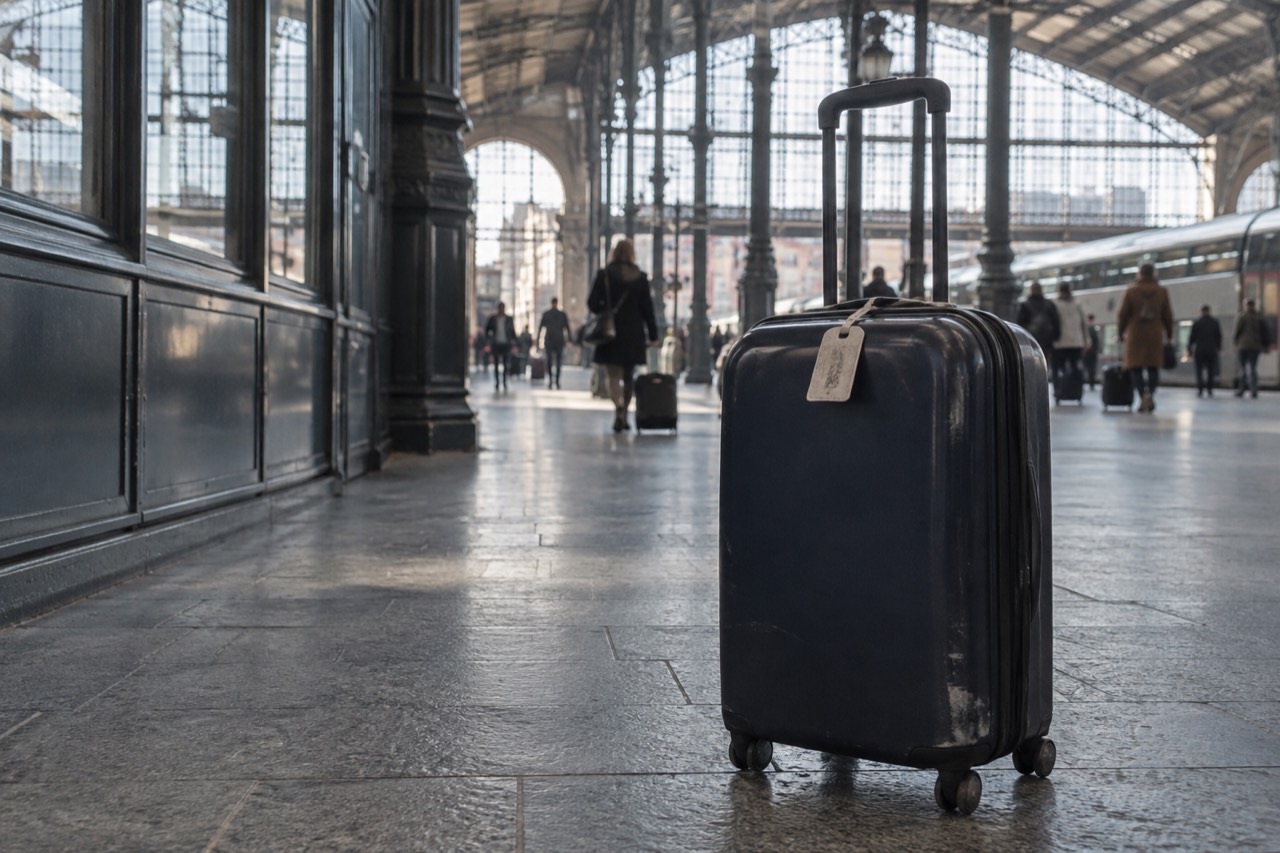
Most people in Paris store their luggage at a storage point clustered around the railway station they arrived at or depart from. Gare du Nord alone has 10 Radical Storage points rated 4.75 across 2,937 reviews, Gare de Lyon has 10 rated 4.79 across 3,009, and the pattern repeats at every mainline terminal. The station cluster wins because it sits on the traveller's existing route, not because it is the cheapest or the only option.
The question sounds casual, but it has a surprisingly consistent answer. When a traveller lands in Paris with a suitcase and a gap before a hotel check-in or an evening train, the decision is almost never "where is the best storage in Paris". It is "where can I put this bag without going out of my way". That reframing explains nearly everything about how storage in the city actually gets used.
The station cluster is the default because Paris is a rail city. The main terminals, Gare du Nord, Gare de Lyon, Gare Montparnasse, Gare de l'Est, Saint-Lazare and Austerlitz, each move huge volumes of arriving and departing passengers every day, and every one of those passengers faces the same gap between arrival time and what they actually want to do next. Where the passengers are, the storage points follow. Radical Storage's own Paris page lists more than 350 published location cards, and the densest clusters sit on the stations, not on the museums or the shopping streets.

This site publishes a directory of those clusters, and the review counts tell the story on their own. The Gare du Nord cluster carries 2,937 reviews across 10 published points. The Gare de Lyon cluster carries 3,009. The Louvre cluster, right in the tourist heart of the city, carries 3,152 across just 5 published points, which is the second half of the pattern: people store bags where their day starts, and for a large share of visitors the day starts at a station even when the sightseeing happens elsewhere. If you are weighing the same choice, the honest first step is comparing the station consigne against a booked storage point, which is exactly what our guide to Paris train station luggage storage does station by station.
The three clusters above are the three most common answers in practice: the Eurostar and TGV hub at Gare du Nord, the Saint-Lazare cluster for the western half of the city where there is no in-station consigne at all, and the Louvre cluster for travellers whose day is anchored in the museum district.
Why The Station Cluster Wins By Default
Travellers store bags at stations because the bag is already there. A storage point only saves time if it sits on a route you were walking anyway, and for most visitors the station is the one fixed point in the day: the arrival, the departure, or both. Price is secondary, hours are secondary, and the guarantee rarely enters the decision at all until something goes wrong.
Think through the actual shape of a Paris trip. You step off a Eurostar at Gare du Nord at eleven in the morning. Your hotel room is not ready and your dinner is at eight. The bag has to go somewhere, and the somewhere that costs you zero extra minutes is the storage point a few hundred metres from the platform you are standing on. Radical Storage's Paris network is built exactly for this: shops, hotels and cafés holding bags behind a counter at EUR 3.90 per bag per day, plus a EUR 1.99 per-bag fee that appears at checkout. One bag for one day works out to EUR 5.89 in arithmetic on those two published figures.
The counter-argument is the official SNCF consigne, and it deserves a fair hearing. At Gare du Nord the staffed SNCF counter charges EUR 4.00 for up to 4 hours, which is cheaper than EUR 5.89, but EUR 9.50 for 12 to 24 hours, which is not. For a short stop the station's own counter wins; for a full day the network price wins. The complication is capacity: SNCF states on its own pages that its station lockers "meet with great success and can sometimes be full", and that they can be temporarily closed for works. A booked storage point does not have that failure mode, and free cancellation any time before the scheduled check-in removes most of the planning risk.
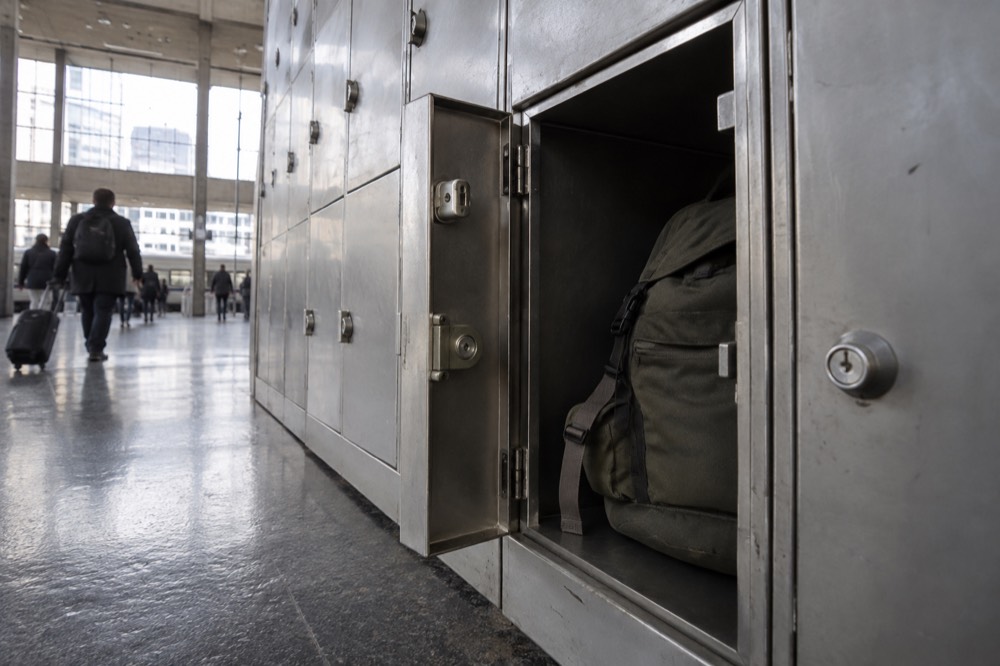
There is one more reason the station cluster dominates, and it is the one nobody advertises: the rules everywhere else. No major Paris museum or monument accepts a full-size suitcase. The Louvre caps bags at 55 x 35 x 20 cm, the Catacombs at 40 x 30 x 20 cm with no cloakroom at all, the Palais Garnier bans travel luggage outright under the Vigipirate security plan, and the Eiffel Tower has no left-luggage office and none nearby. A traveller who tries to drag a suitcase to the sights discovers quickly that the bag has to land somewhere first, and the station is where they are standing when they discover it.
The Gare du Nord cluster is the single most used answer in the city, which is why it anchors this site's directory. It has the deepest inventory, the longest spread of opening hours, from 07:30 at the earliest point to 23:59 at the latest, and it sits on the RER and Metro interchange that connects to everything else.
Booking a Gare du Nord point also answers the question this article opened with in miniature: it is the cluster most people default to, and it earns that default honestly, with the deepest inventory in the city and hours that cover almost any train time. If your own plans run through a different terminal, the same logic applies there, and the rest of this article covers the alternatives worth knowing.
What The Two Main Options Actually Cost
A booked Radical Storage point in Paris costs EUR 3.90 per bag per day plus a EUR 1.99 per-bag checkout fee, so one bag for one day is EUR 5.89. The official SNCF consigne runs EUR 5.50 to EUR 9.50 per fixed 24 hours by locker size, plus EUR 5 per further 24 hours. The consigne wins short stops, the network wins long ones.
The arithmetic matters because the marketing on both sides obscures it. Radical Storage advertises "from EUR 1.90/day" in Paris, but across 329 Paris location cards counted in this site's research, 316 showed EUR 3.90, 10 showed EUR 1.90, all in the Bercy cluster, and 3 showed EUR 5. The EUR 1.90 is a global marketing floor, not a Paris price, and a reader budgeting on it will be wrong by about half. The EUR 1.99 fee is charged once per bag and does not scale with nights, which is why three days costs EUR 13.69 rather than three times EUR 5.89.
| Scenario | Radical Storage point | SNCF consigne (Gare de Lyon grid) | Cheaper option |
|---|---|---|---|
| 1 bag, 4 hours | EUR 5.89 (EUR 3.90 + EUR 1.99) | EUR 4.00 at Gare du Nord staffed counter | Consigne |
| 1 bag, 24 hours | EUR 5.89 | EUR 5.50 small to EUR 9.50 large | Network, for a small bag |
| 1 bag, 3 days | EUR 13.69 | EUR 15.50 small (EUR 5.50 + 2 x EUR 5) | Network |
| Saint-Lazare or Bercy | EUR 5.89 per day | No in-station consigne exists | Network, by default |
Two caveats keep that table honest. First, the SNCF figures come from the operator's own consigne pages, and payment terms vary sharply by station: Gare de Lyon has historically been cash only but is being refitted during September 2026 to card-only lockers, Gare de l'Est takes coins only, and Montparnasse takes card only. Arriving with the wrong payment method is a real failure mode. Second, the EUR 5.89 and EUR 13.69 totals are arithmetic on Radical Storage's two published figures, not observed checkout totals; the fee appears at the checkout stage rather than on the location card, which is worth knowing before you are surprised by it.
The last row is the strongest fact in the whole comparison. Saint-Lazare and Bercy have no in-station consigne at all: SNCF's own 13-station list omits both, and its June 2026 partner tender treats them as off-site partner stations. In the western half of Paris, a booked storage point is not the alternative to the official option, it is the only realistic option, which is why the Saint-Lazare cluster, 10 points rated 4.79 across 2,305 reviews, exists at all.
What About Museums And Landmarks?
Most people do not store luggage at museums, because almost none of them will take a suitcase. The Louvre's free lockers accept only what fits under its 55 x 35 x 20 cm cap, the Eiffel Tower and Arc de Triomphe have no cloakroom at all, and the Catacombs ban anything over 40 x 30 x 20 cm. The museum-adjacent storage clusters exist to receive the bags the venues refuse, not to compete with them.
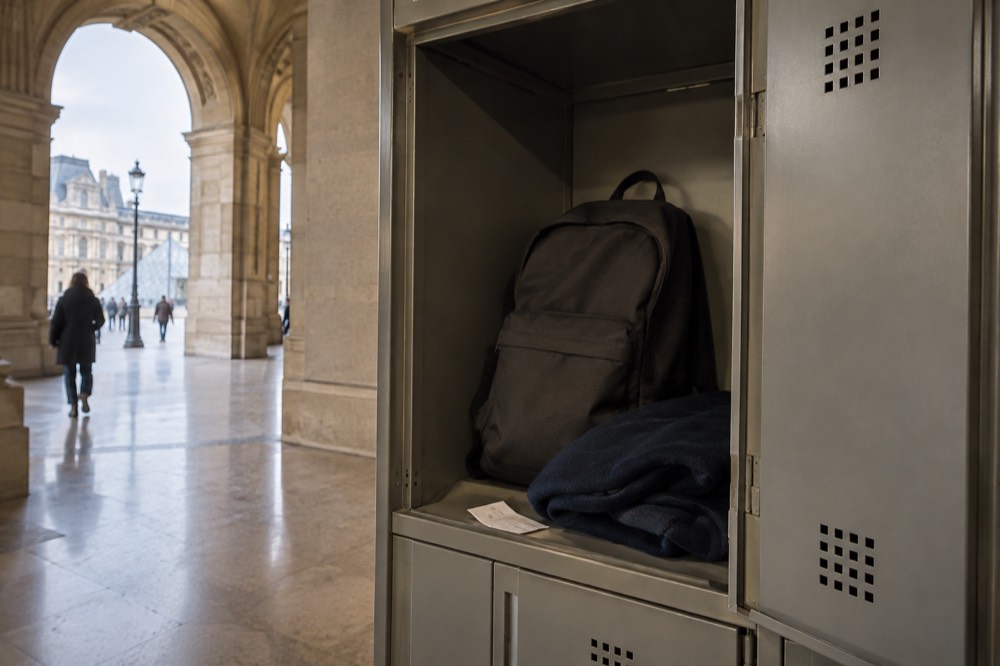
The Louvre is the interesting case because it does offer something. Self-service lockers beneath the Pyramid and at the Porte des Lions are free, and for a traveller carrying only a daypack or a small cabin bag they solve the problem at zero cost. But the museum's own amenities page states that items exceeding 55 x 35 x 20 cm are not permitted anywhere in the museum, that everything left in the lockers must be collected the same day, that the Porte des Lions side closes at 3 p.m., and that the museum is not responsible for valuables placed in the lockers. A free locker that cannot hold your bag, and that disclaims responsibility for your laptop, is not where most people store luggage. It is where people store coats.
That is why the Louvre storage cluster on this site carries 3,152 reviews across only 5 published points: a small number of points absorbing a very large number of refused suitcases. The same dynamic shapes the Eiffel Tower cluster, 9 points rated 4.8 across 1,559 reviews, which exists because the tower itself publishes that there is no left-luggage office, no cloakroom, and no lockers in or near the monument, with a physical gauge at security setting a maximum size that is not published in centimetres anywhere. Everything else covered here is indexed on Luggage Storage in Paris.
The practical rule to take away: check the venue's bag limit before you plan your day around its locker, and assume a checked suitcase is refused everywhere. If your bag fits the venue's own limit, the free option is genuinely free. If it does not, the nearest Radical Storage cluster is the answer, and booking it near the venue rather than back at the station saves you a return trip. This site's guide to Paris museum and landmark bag rules collects the published limits venue by venue so you can check in one place.
Where Airport Travellers Store Their Bags
Airport travellers store bags either at the airport's own left-luggage desk or, far more often, at a station cluster in central Paris, because Radical Storage has no storage point at Charles de Gaulle or at Orly. Both airport pages on the network's site exist but carry zero inventory, so the honest answer for most people is to take the bag into town and store it at the station end of the journey.
The airport desk is real. Bagages du Monde runs the left-luggage service at both airports, with one desk per airport: at CDG Terminal 2 by the TGV station, and at Orly Terminal 3 near the Metro line 14 arrival at Gate 33a. It opens 07:00 to 21:00 every day, takes payment by card, PayPal and the mobile wallets, and publishes an indicative price list on its own terms page: from EUR 3 per hour or EUR 10 per day for carry-on bags, from EUR 4 per hour or EUR 15 per day for medium, and from EUR 5 per hour or EUR 20 per day for large. Those are the operator's own indicative rates, not an observed checkout, and there is a 2-hour minimum.
Two details from the operator's own pages that almost nobody publishes. First, the desk accepts a bag only after an identity check that takes a national ID card or a passport only: a driving licence will not get your bag accepted. Second, the bags are X-rayed and scanned before storage, which is a genuine security procedure rather than a marketing claim.
But the price gap explains the behaviour. A large suitcase for one day at the airport desk is EUR 20 indicative. The same bag at any central Paris storage point is EUR 5.89 all-in. For a traveller with a long layover who wants to see the city, the arithmetic pushes the bag onto the RER and into a station cluster, which is exactly what most people do. The one thing this site will not do is imply you can drop a bag with the storage network at either airport, because you cannot, and saying so plainly is more useful than a flattering half-truth.
Hotels: The Option People Ask About First
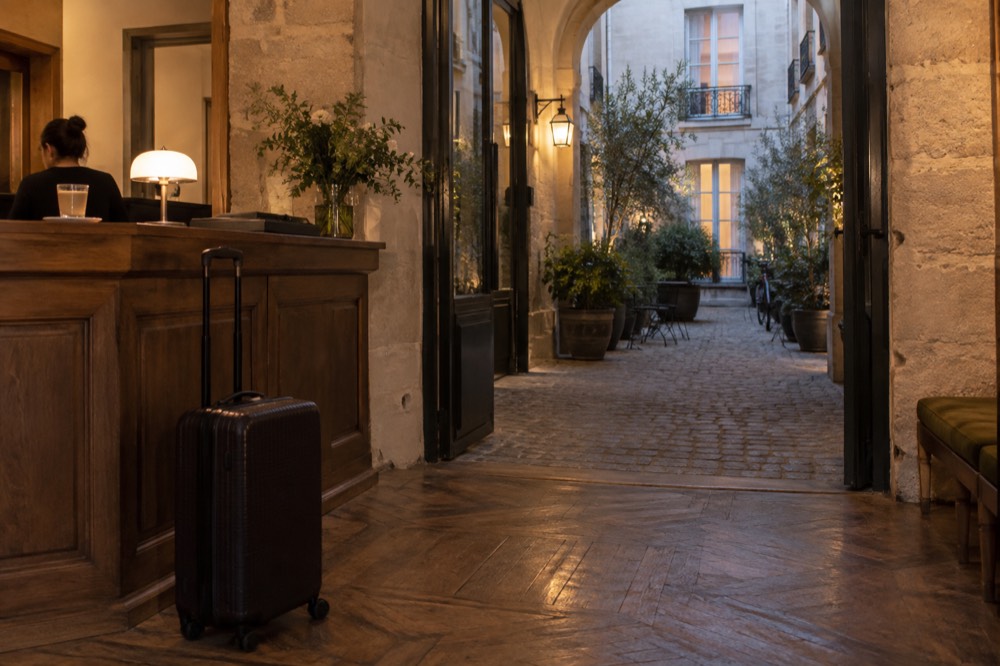
Hotels are the first idea most travellers have and the least reliable answer. A hotel you are staying at will usually hold your bag before check-in and after checkout, but whether a Paris hotel holds luggage for a non-guest is not published by any major chain, and French law caps a hotelkeeper's liability for a guest's effects at one hundred times the nightly room rate.
The legal cap deserves a moment because it reframes the "just leave it at the hotel" instinct. Under article 1953 of the French Civil Code, a hotelkeeper's liability for a guest's effects is capped at one hundred times the daily room price, unless the loss is proved to be the hotel's fault. That multiple is the only published figure, so what it means in euros depends entirely on what your room costs, and the cap can be far lower than the value of a bag containing a laptop and a camera. The regime attaches to travellers who lodge there, and no published policy from any chain answers whether it extends to a bag held for someone who is not a guest. That question is genuinely unresolved in this site's research, and any page claiming a firm answer either way is guessing.
What is verifiable is that hotels participate in the storage network itself. Radical Storage's Paris page lists hotel-typed location cards alongside shops and restaurants, so the boundary between "my hotel holds it" and "a hotel holds it, booked through the network" is thinner than it looks. The difference is what backs the bag: a network booking carries the Radical Storage guarantee, advertised at EUR 10,000 but capped in the binding terms at EUR 3,000 per claim, and it is explicitly not insurance. The terms also carry procedural teeth worth knowing before you hand anything over: a claim must be notified within seven days of discovering loss or damage, theft must be reported to police within 48 hours, and a claim is invalid without a signed list of the bag's items and their values. Photograph your bag's contents before you drop it. That single habit is the difference between a valid claim and no claim.
For the practical version of the hotel question, including what to do on your final day when checkout is at noon and the flight is at night, this site's last day in Paris with a suitcase guide walks the timing decisions hour by hour.
How To Pick Your Own Spot In Thirty Seconds
Pick the cluster nearest the fixed point of your day: your arrival station, your departure station, or the district you will actually be walking. Book the point whose published hours cover your pickup time, not the cheapest card on the page, because hours vary per point and no Paris storage point is open around the clock. Then confirm the total, EUR 3.90 per bag per day plus EUR 1.99 per bag, before you commit.
Hours are where lazy planning fails. The 10 points in the Gare du Nord cluster that publish opening hours open as early as 07:30 and close as late as 23:59, but those are the extremes of different points, not one point's schedule: the Gare du Nord Grandes Lignes point itself runs 08:30 to 20:00. The Montparnasse cluster spans 07:00 to 23:59 across its points. The Louvre cluster, unusually, stops at 22:00 at the latest. Every one of those figures comes from the individual point's own record, and generalising them across the network is how travellers end up locked out of their own suitcase at nine in the evening.
The network's own published material is worth reading with the same care. Radical Storage's Paris page, radicalstorage.com/luggage-storage/paris, markets a 4.8 rating across 646K global reviews and free cancellation, and the cancellation term is real and useful: any time before the scheduled check-in, full refund. The rating figures are the network's own claims rather than an audited number, and the EUR 10,000 guarantee headline always needs the EUR 3,000 per-claim cap beside it to be an honest sentence. None of that makes it a bad product; it makes it a product whose terms you should read once before relying on them.
So, circling back to the question in the title. Most people store their luggage at the station cluster nearest their train, a minority store it in the museum districts where their day happens, airport travellers split between an expensive desk airside and the cheap clusters in town, and hotels fill the gaps for their own guests. The pattern is not mysterious. Bags follow routes, and in Paris the routes all start and end at stations.
Common Questions About Where People Store Luggage In Paris
Where Do Most People Store Their Luggage?
Most travellers in Paris store luggage at a storage point clustered around their arrival or departure station. Gare du Nord, Gare de Lyon and the Louvre area carry the heaviest review volumes, at 2,937, 3,009 and 3,152 reviews respectively across their published points, all at EUR 3.90 per bag per day plus the EUR 1.99 checkout fee.
Is It Cheaper To Use The Station Consigne Or A Storage Point?
For a short stop the SNCF consigne is cheaper: EUR 4.00 for up to 4 hours at Gare du Nord against EUR 5.89 for a full day at a storage point. For a full day or longer the storage point usually wins, and at Saint-Lazare and Bercy there is no in-station consigne at all, so a booked point is the only realistic option.
Can I Store A Suitcase At A Paris Museum?
Almost never. The Louvre bans anything over 55 x 35 x 20 cm from the entire museum, the Catacombs cap bags at 40 x 30 x 20 cm with no cloakroom, and the Eiffel Tower, Arc de Triomphe and Sainte-Chapelle have no left-luggage facility at all. Museum-adjacent storage clusters exist to receive the bags the venues refuse.
Can I Leave My Bag At Charles de Gaulle Or Orly Airport?
Yes, at the Bagages du Monde desk at each airport, open 07:00 to 21:00, with indicative rates from EUR 10 per day for carry-on up to EUR 20 per day for large bags and a 2-hour minimum. Radical Storage has no storage point at either airport, so the cheaper route for most travellers is to take the bag into Paris and store it at a station cluster.
Will A Paris Hotel Hold My Luggage If I Am Not A Guest?
There is no published policy from any major chain answering this, so ask rather than assume. For guests, hotels will usually hold bags before check-in and after checkout, but liability is capped by French law at one hundred times the nightly room rate, and a network booking with its EUR 3,000 per-claim guarantee cap may cover more of a valuable bag than an informal hotel favour.
What Does One Bag For One Day Actually Cost?
At a Radical Storage point in Paris, EUR 3.90 for the day plus the EUR 1.99 per-bag checkout fee, which is EUR 5.89 in arithmetic on the two published figures. The fee is charged once per bag, so three days with one bag is EUR 13.69, not three times the one-day total.