Will A Hotel Hold My Luggage In Paris If You Are Not Staying There?
Every traveller tries the free option first: walk into a hotel, smile at reception, ask them to keep the bag for the afternoon. Here is what actually happens when you do that in Paris, what the hotel is on the hook for if it says yes, and what the paid alternative costs when it says no.
Short answer
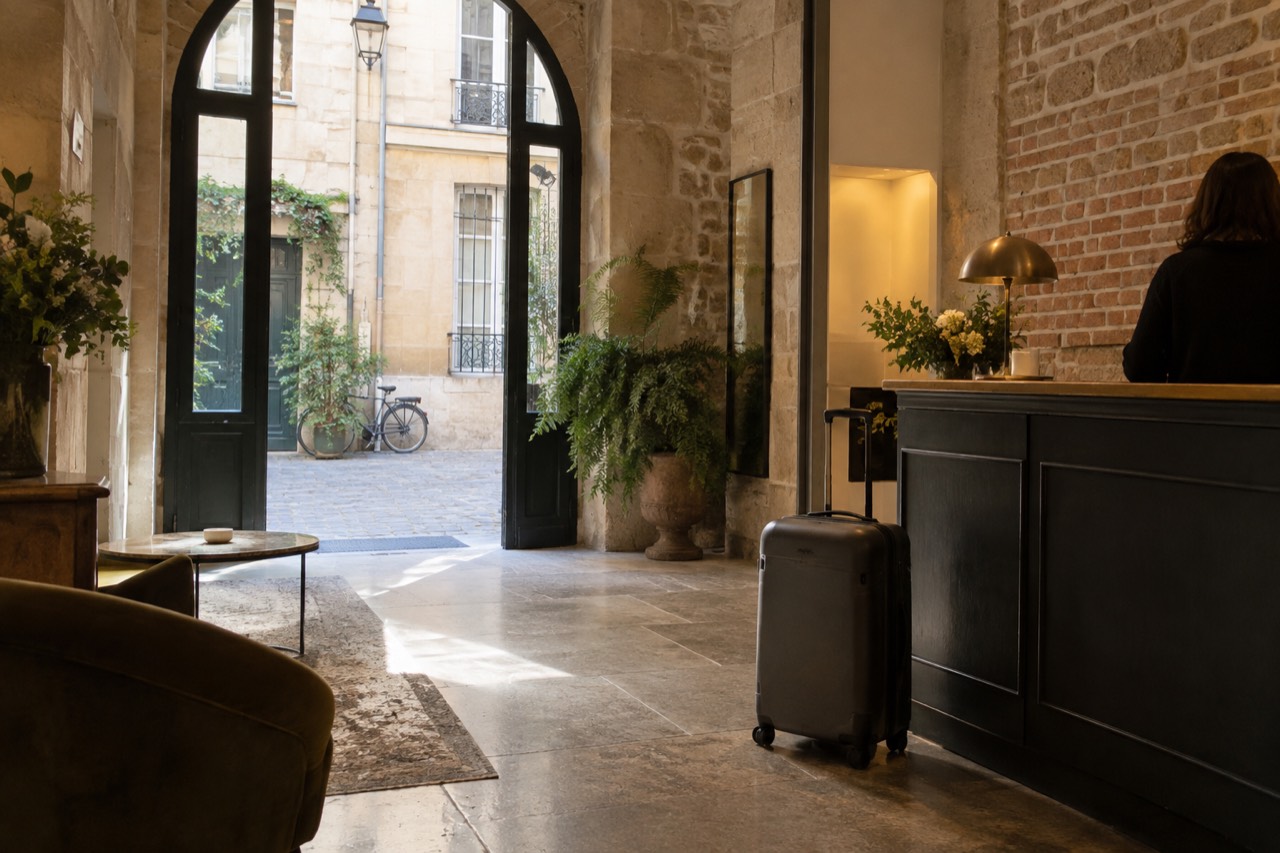
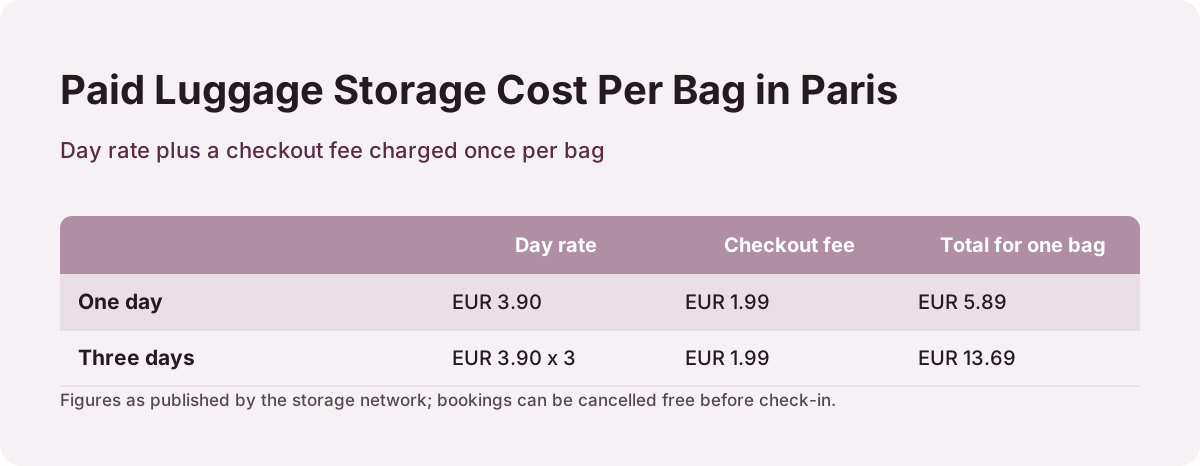
No Paris hotel chain publishes a policy on holding bags for non-guests, so the answer depends entirely on the desk you ask. Many refuse non-guests on liability grounds. Guests usually get before-check-in and after-checkout storage free. A paid Radical Storage point costs EUR 3.90 per bag per day plus a EUR 1.99 checkout fee, EUR 5.89 for one bag for one day.
The suitcase problem always arrives at the worst hour. You have checked out at noon, your train leaves at eight, and the bag is too big for the Louvre, too big for the Catacombs, and too heavy to drag across the Marais all afternoon. The first idea almost everyone has is free: find a hotel, any hotel, and ask reception to keep the bag for a few hours.
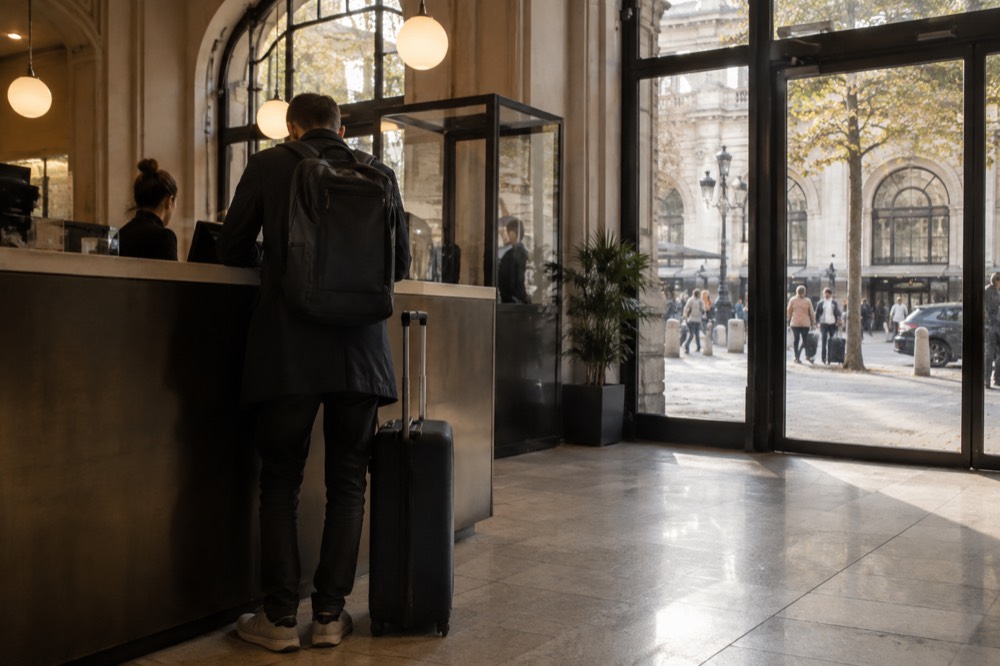
This guide gives the honest version of that plan. It covers what happens when you ask a hotel you are not staying at, what hotels do for their own guests, what French law says a hotel owes you when it takes your bag, and what a paid luggage storage point costs when the answer at the desk is no. The short version: the free option is real but never guaranteed, and the fallback costs EUR 3.90 per bag per day plus a EUR 1.99 checkout fee, so EUR 5.89 for one bag for one day.
Will A Hotel Hold My Luggage If I Am Not Staying There?
There is no published answer, and that is the honest starting point. No hotel chain operating in Paris publishes a written policy on holding luggage for people who are not staying there. The decision is made case by case at the reception desk, and the practical expectation should be a polite refusal. If a hotel does accept, it is doing you a favour on unwritten terms, not providing a service it stands behind.
That is not a cop-out; it is the finding. The research behind this site looked for a published bag policy from every major chain operating in Paris and found none. What exists instead is a wall of individual anecdotes: some travellers report a friendly desk keeping a bag for a few euros or for free, others report a flat no before they finished the sentence. Both are true, because each desk decides for itself.
The reasons a hotel says no are practical rather than rude. A luggage room is a liability: the hotel does not know you, has no payment from you, and in France takes on legal responsibility for goods it holds (more on that below, because the liability is real). Storage space is finite. Security screening is impossible: unlike a paid storage point or an airport desk, nobody X-rays what you hand over. And a desk that says yes to one non-guest has no principled reason to say no to the next fifty.
So the realistic playbook is this. Ask, politely, at a hotel that has an obvious reason to help you: the one next to your departure station, the one where you are staying later in the trip, or the one where a friend is a guest. Offer something in return, a tip or buying a drink at the bar. Ask early in the day, when the luggage room is empty and the desk is calm, not at five in the afternoon when it is full. And have the paid fallback ready rather than betting your last afternoon on a stranger's goodwill.
Can I Ask A Random Hotel To Hold My Luggage?
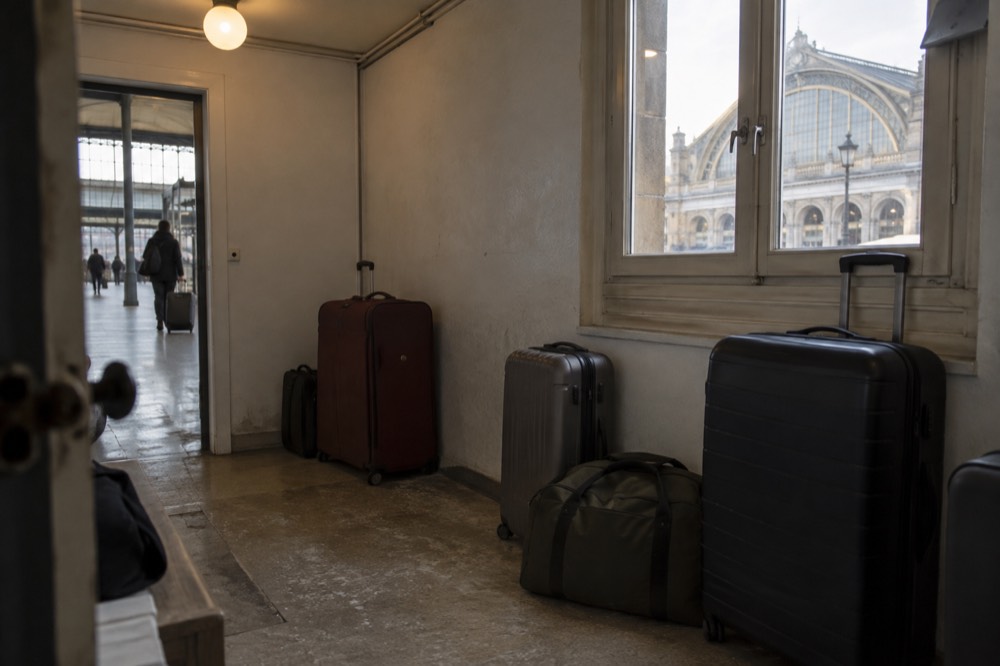
You can ask any hotel, and nobody will be offended, but the odds are against you and you should never build a plan around it. A hotel that accepts a bag from a stranger takes on legal responsibility for it without payment, which is why most desks decline. The only guarantee you can book in advance is a paid storage point, at EUR 3.90 per bag per day plus the EUR 1.99 checkout fee.
There is a real difference between asking and expecting. Asking a random hotel is a five-minute gamble with a suitcase: you walk in, you ask, and either it works or you walk out and try the next option. Expecting it to work is where travellers get stranded, because they budgeted their time on an assumption no hotel ever promised.
A few situations tilt the odds in your favour. If you are staying at that hotel later in your trip, say so, and show the booking: the desk is holding a bag for a future guest, not a stranger. If you are in the same building complex or the hotel belongs to the group whose loyalty programme you carry, mention it. If you ate at the restaurant or used the spa that morning, you are a customer of the business even if not a hotel guest. None of these entitle you to anything, but they change the question from "help me for free" to "help a customer".
What tilts the odds against you is asking the wrong hotel. A small boutique property with no luggage room will say no because it physically has nowhere to put the bag. A luxury palace hotel will often say no because its insurance and its brand standards do not allow it. The mid-range and business chains are the middle ground, and even there the answer is desk-dependent. For a deeper look at the question from the hotel side, see do Paris hotels offer luggage storage, and for the exact version of this question with the same honest caveat, will a hotel hold my luggage if I'm not staying there.
The one thing not to do is leave a bag somewhere semi-official and walk away: propped in a lobby corner, next to the concierge desk, by the lift. An unattended bag in a French station or on the network triggers a security protocol, and SNCF's own figures say it takes 19 minutes on average to deal with one, with 360 items left behind every week. A hotel lobby is calmer than a station, but the principle is the same: a bag nobody is watching is nobody's responsibility.
Do Hotels In Paris Offer Luggage Storage For Their Own Guests?
Yes, and this is the dependable half of the free option. If you are staying at the hotel, virtually every Paris property, from two-star to palace, will keep your bags on the day you arrive before check-in and on the day you leave after checkout. It is a standard part of the service for guests, usually free. No chain publishes how long it will hold a bag, so same-day collection is the safe assumption.
The guest version of hotel luggage storage is the one you can actually plan around. Arriving at ten in the morning with a room that opens at three? Hand the bags to reception, get a claim tag, and go see the city. Checking out at noon with an evening train? Same. The hotel knows you, has your payment details, and has every reason to look after you.
The honest limits are these. First, hours: the luggage room is reachable only while reception is staffed, which in a small property may not be as late as you need. Second, duration: nothing is published about holding a bag overnight or for several days after checkout, so ask before assuming, and expect "same day" to be the default answer. Third, valuables: a hotel luggage room is typically a shared, sometimes unlocked space, which is a very different thing from a staffed storage point with a booking record and a guarantee. The safety question deserves its own section below.
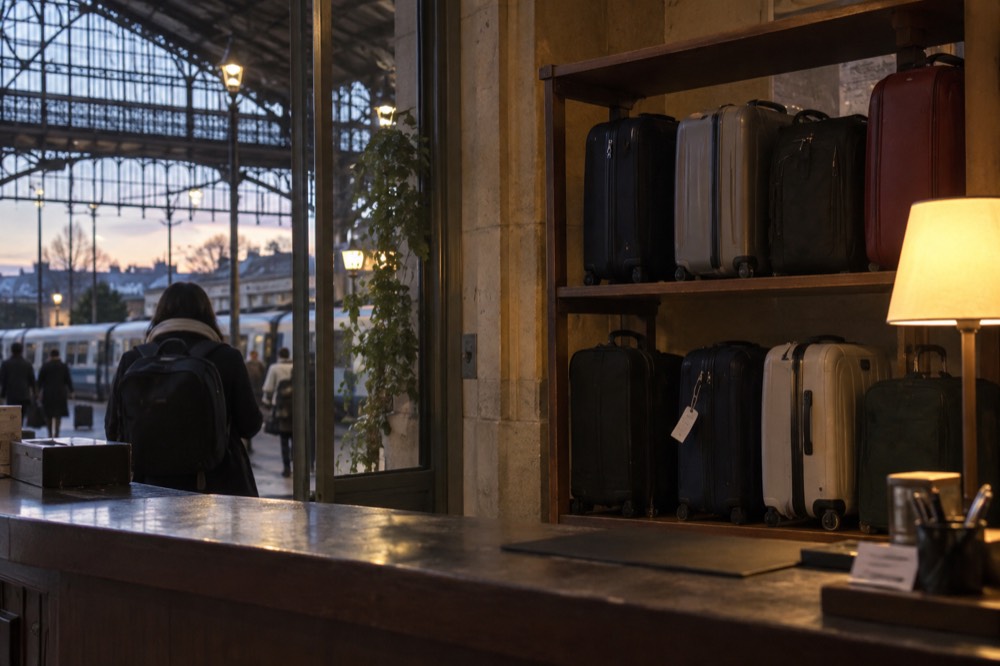
One structural detail is worth knowing, because it connects the two halves of this article. Some of the paid storage points on this site's network are themselves hotels: Radical Storage's Paris roster includes properties typed "Hotel", alongside shops, restaurants and local businesses, and one hotel point was even showing "Closed" on its card at the time of research. So the line between "hotel that holds bags" and "paid storage point" is thinner than it looks: the difference is that a Radical Storage hotel point has published hours on its card, a booking record, and the network's guarantee behind it, while a favour at reception has none of those.
| Situation | Will the hotel keep the bag? | What you get | What to watch |
|---|---|---|---|
| Guest, before check-in | Almost always yes, free | Claim tag, luggage room | Collect before reception closes |
| Guest, after checkout, same day | Almost always yes, free | Claim tag, luggage room | Confirm the cut-off time in advance |
| Guest, after checkout, overnight or longer | Ask; no published policy | Varies by property | Never assume; get the answer in writing |
| Non-guest, walk-in | Usually no, sometimes yes | A favour, on unwritten terms | No booking, no guarantee, no receipt |
For the timing that makes this matter, Paris hotel check-in and checkout times covers the gaps between arrival, departure and the hours your room actually exists.
Is Hotel Luggage Storage Safe?
Usually yes, and usually is doing real work in that sentence. A hotel luggage room is a low-theft, low-security space: incidents are rare, but nothing about it is engineered to stop one. There is no X-ray, no per-bag scan, no sealed tag and no camera guarantee any Paris hotel publishes. If your bag contains a laptop, medication or documents, a staffed storage point with a booking record is built for that job.
Start with what is real. Paris hotels hold thousands of bags a day and the overwhelming majority are returned exactly as left. Reception hands you a numbered tag, and the tag is the system. For a day bag with clothes and a spare pair of shoes, that system is fine. Everything else covered here is indexed on Luggage Storage in Paris.
Now the honest caveats. The luggage room is often a shared space, sometimes unlocked, sometimes reachable by other guests as well as staff. No Paris hotel publishes a security procedure for stored bags, and this site's research could not verify a single documented theft from a Paris hotel luggage room in 2024 to 2026, which cuts both ways: there is no wave of thefts, and there is also no evidence base saying the risk is zero. What can be stated is structural: a favour at reception creates no record of what was in your bag, and a dispute about a missing item with no inventory is a dispute you will lose.
The paid alternative is engineered differently, and the differences are checkable rather than vibes. A Radical Storage booking creates a record of the drop-off, and the network's guarantee is capped at EUR 3,000 per claim under clause 9.4 of its terms, against the EUR 10,000 headline figure it advertises. The terms also state plainly that the guarantee is not insurance and does not constitute a contract of insurance. Two deadlines matter if something goes wrong: you must notify the company within seven days of discovering a loss, and if a bag is stolen, the police report must be made within 48 hours. One exclusion is worth acting on before you hand any bag to anyone: claims require a signed, itemised list of the bag's contents with estimated values, so photograph and list what is inside before you drop it off. For the full picture on the paid side, see is Paris bag storage safe.
What A Hotel Owes You If Your Stored Bag Goes Missing
More than most people assume, and less than the value of your bag. French Civil Code article 1953 caps a hotelkeeper's liability for a guest's effects at a hundred times the daily room price, unless you can prove the loss was the hotel's fault. That cap is a maximum, not a promise, and it attaches to guests who lodge there. For a non-guest doing a favour-based drop, the legal position is far murkier.
The legal detail is genuinely useful, so it is worth stating precisely. Article 1953 of the French Civil Code sets the hotelkeeper's liability for the clothing, luggage and effects of travellers who lodge at the hotel, capped at a hundred times the daily room price, to the exclusion of any lower contractual limit, unless the traveller proves the fault of the hotel. A separate, lower cap of fifty times the room price applies to items left in a vehicle parked on premises the hotel has exclusive use of. The underlying duty, from article 1952, treats the hotel as a depositary of your things (the article is on Légifrance).
Two honest qualifications follow. First, a cap is a ceiling: it says what the hotel could owe at most, not what it will pay, and you would still need to prove what was in the bag. Second, and this is the part that matters for the non-guest question, article 1952 attaches to travellers who lodge there. Whether a hotel holding a stranger's bag falls under this regime at all is a legal grey zone, and this site will not dress a guess up as law. The practical conclusion writes itself: a bag held as a favour is a bag whose legal position you cannot state in advance. A booked storage point has terms you can read before you hand over the suitcase.
| Who holds the bag | Legal basis | What they could owe | What you must be able to prove |
|---|---|---|---|
| Your hotel (you are a guest) | Civil Code arts. 1952-1953 | Up to a hundred times the nightly room price | What was in the bag, and ideally the hotel's fault |
| A hotel holding it as a favour | Unclear; likely ordinary bailment | Unknown in advance | Everything, with no agreed terms |
| A Radical Storage point | Booking terms, clause 9 | Up to EUR 3,000 per claim (EUR 10,000 headline) | Signed itemised list of contents with values, reported within 7 days |
The habit that protects you under every row of that table is the same: photograph the bag, photograph the contents, and keep the photos timestamped on your phone. It costs two minutes and it is the single thing that turns a lost-bag argument from your word against theirs into a claim.
What To Do When The Hotel Says No
When the hotel says no, book a backup with Radical Storage, whose standard Paris rate is EUR 3.90 per bag per day plus a EUR 1.99 fee per bag at checkout, so one bag for one day totals EUR 5.89 and one bag for three days totals EUR 13.69, since the fee is charged only once per bag. Bookings can be cancelled free before check-in.
The arithmetic matters because the day rate alone understates a one-day booking by about a third. EUR 3.90 is what the day costs; EUR 1.99 is what the booking costs; EUR 5.89 is what leaves your card. For a multi-day hold the fee matters less, since it is charged once per bag: three days with one bag is EUR 3.90 x 3 plus EUR 1.99, which is EUR 13.69. These are sums worked on the network's two published figures, not an observed checkout total, so treat them as planning numbers and check the final figure when you book.
Where you book is mostly a question of where your day is going. If the plan is the Louvre, a storage point near the museum puts the bag within a short walk of the entrance, which matters because the Louvre bans anything over 55 x 35 x 20 cm and its free lockers stop being collectable after 3 p.m. at the Porte des Lions. The network's Louvre area runs at EUR 3.90 per bag per day plus the EUR 1.99 fee, with points opening as early as 07:00 and closing as late as 22:00, and a 4.8 rating across 3,152 reviews on the area's published points. Check storage near the Louvre for the current cards and hours.
If your day runs the other way, the same logic applies on the Right Bank. The Arc de Triomphe has no left-luggage office at all and caps bags at 40 x 40 x 20 cm, so a suitcase has to go somewhere before you climb the terrace; the network's arc-de-triomphe area runs at EUR 3.90 plus the fee, with points from 09:00 and a 4.73 rating across 1,327 reviews. And if you are connecting through the transport hub, Chatelet-Les-Halles storage puts a drop at the centre of the RER and Metro network, EUR 3.90 plus the fee, points from 08:00 to as late as 23:00, rated 4.76 across 2,979 reviews.
| Drop-off plan | Typical cost, one bag, one day | Why it fits |
|---|---|---|
| Hotel favour, non-guest | Free if accepted | No booking, no guarantee, answer depends on the desk |
| Hotel as a guest, same day | Free | Dependable, but only on arrival and departure days |
| Radical Storage point, one day | EUR 3.90 + EUR 1.99 = EUR 5.89 | Bookable, hours on the card, guarantee capped at EUR 3,000 per claim |
| Radical Storage point, three days | EUR 3.90 x 3 + EUR 1.99 = EUR 13.69 | Fee is once per bag, so multi-day holds get cheaper per day |
How Hotel Storage Compares With A Station Locker Or A Paid Point
For a guest on arrival or departure day, the hotel is the best option and it is free. For everyone else, the honest ranking depends on time and station: the SNCF consigne is cheaper for a short stop, EUR 4.00 for up to four hours at Gare du Nord, but more expensive for a long one at EUR 9.50 for twelve to twenty-four hours. Saint-Lazare and Bercy have no in-station consigne at all.
The station comparison is worth doing properly because it is the one place where official, published figures exist on both sides. At Gare du Nord, the SNCF consigne charges EUR 4.00 for up to four hours, EUR 7.50 for four to twelve hours and EUR 9.50 for twelve to twenty-four hours, open 06:15 to 23:15 daily. Against that, a Radical Storage point is EUR 5.89 all-in for the day. So for a short stop the station wins; for anything approaching a full day the gap closes; and the station locker has a capacity problem the operator admits itself: SNCF's own pages state that the lockers "meet with great success and can occasionally be full", and can be closed for works. A booked point cannot be full, because the booking is the capacity.
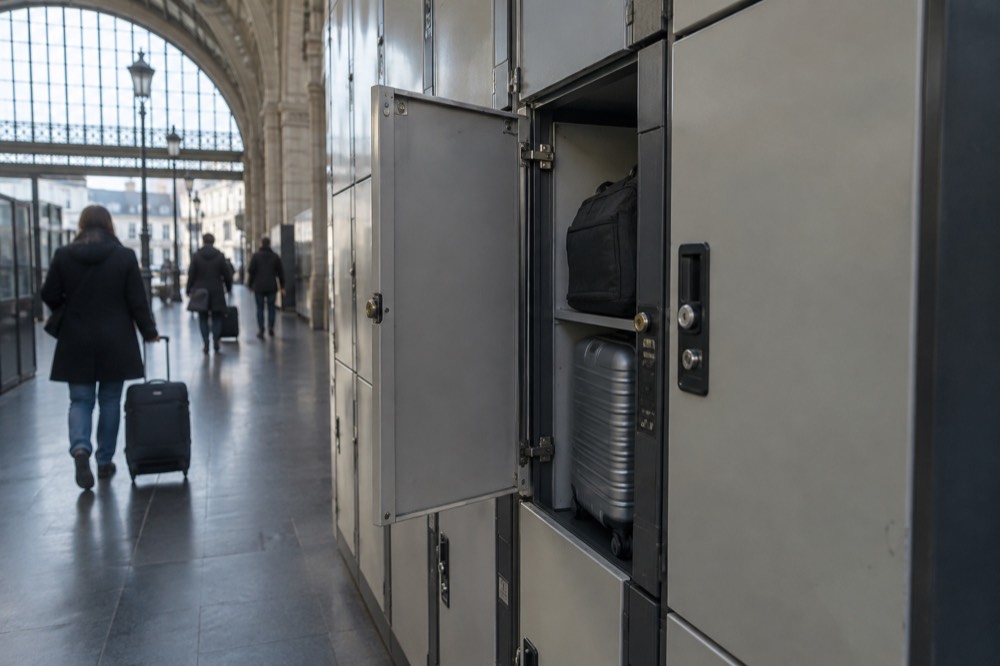
The station map has holes, and knowing them saves a wasted walk. SNCF's own 13-station list includes consignes at Gare du Nord, Gare de Lyon, Montparnasse, Est and Austerlitz, but not Saint-Lazare and not Bercy: both are handled through an off-site partner within roughly five minutes' walk, per SNCF's own tender documents. Payment quirks matter too: the Gare de Lyon lockers have been cash-only, though SNCF has announced a refit to card-only machines during September 2026, so carry both. Gare de l'Est is coins-only, Montparnasse is card-only, Austerlitz is cash-only. A hotel favour and a network point both sidestep the coin problem entirely.
The third leg of the comparison is the one this article started with. A hotel favour is free but unguaranteed. A station locker is cheap but capacity-limited and payment-quirky. A booked point is the only option that can be reserved before you leave home, with hours printed on the card and a guarantee behind the booking. For the full station-by-station detail, Paris train station luggage storage covers every consigne, and what luggage storage costs in Paris works the price arithmetic end to end.
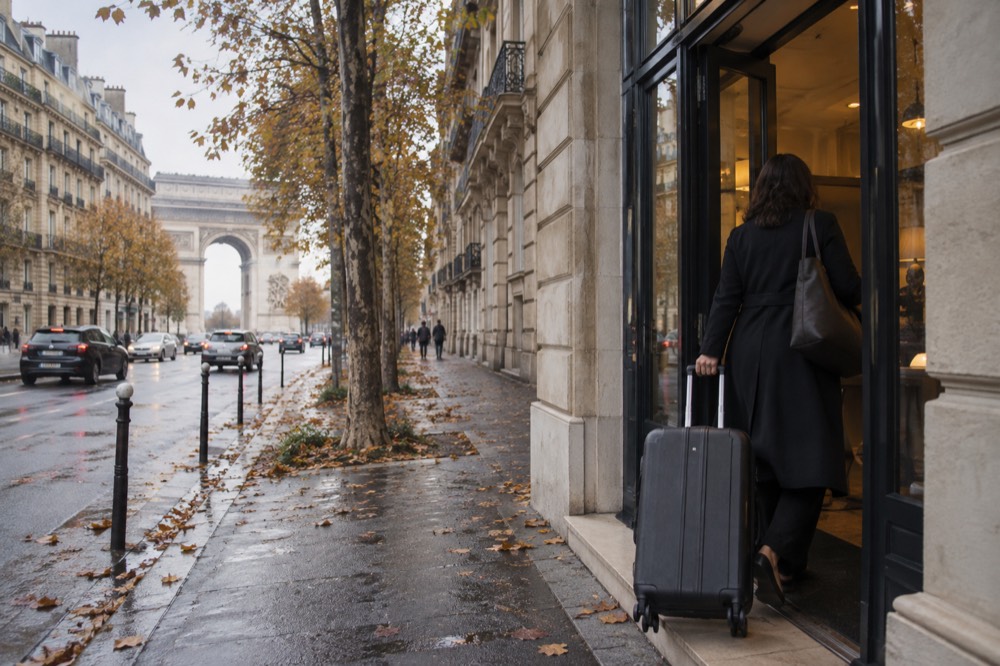
Whichever of these three areas fits your day, the pattern is the same: pick the point whose hours match your plan, book it before you leave the hotel, and photograph the bag's contents before you hand it over. That is the whole routine, and it takes less time than asking at three reception desks in the hope of a free favour.
Common Questions About Hotel Bag Storage In Paris
Will a hotel hold my luggage if I'm not staying there?
Sometimes, but never count on it. No Paris hotel chain publishes a policy on non-guest bag storage, so the answer depends entirely on the desk you ask, and many decline on liability grounds. If a hotel does accept, it is a favour on unwritten terms, with no booking record and no guarantee. A booked Radical Storage point costs EUR 3.90 per bag per day plus the EUR 1.99 checkout fee and can be reserved in advance.
Can I store luggage at a hotel if I'm not staying there?
You can ask, and asking is free, but the realistic expectation is a refusal. Your odds improve if you are staying at that hotel later in your trip, if you are a customer of its restaurant or spa, or if you offer a tip. The only storage you can guarantee in advance is a paid point or, at five stations, the official SNCF consigne.
Can I ask a random hotel to hold my luggage?
Yes, and nobody will be offended, but build a plan B. Mid-range and business hotels are the most likely to say yes; small boutiques often have no luggage room and luxury palaces often refuse on policy. Ask early in the day, be brief, and have a booked alternative ready rather than betting your afternoon on goodwill.
Do hotels in Paris offer luggage storage for guests?
Yes, and for guests it is dependable: virtually every Paris property keeps bags on your arrival day before check-in and on your departure day after checkout, usually free, with a numbered tag. The limits are hours and duration: collect before reception closes, and assume same-day is the default, since no chain publishes a longer hold.
Is hotel luggage storage safe?
Usually, but a luggage room is a low-security space: no X-ray, no sealed tag, no published security procedure. For clothes and shoes it is fine; for a laptop or documents, a staffed storage point with a booking record is built for the job. Photograph your bag's contents before any drop, since paid-network claims require a signed itemised list of contents with values.
What happens if my bag goes missing at a Paris hotel?
If you were a guest, French Civil Code article 1953 caps the hotel's liability at a hundred times the nightly room price, unless you prove the hotel's fault. If you were not a guest, the legal position is unclear because the deposit rules attach to travellers who lodge there. In both cases you must prove what was in the bag, which is why a timestamped photo inventory is worth the two minutes.